
Is Your Air Conditioning Making the Mold in Your House?
Yes, it can be, and not because the unit is faulty. NOAA's thirty year normals for the New Orleans airport station put the mean dew point at 75.2F in July and 75.1F in August, at or above the temperature a cooled house holds its walls at, so the air conditioning makes the cold surface and the outdoor air brings the water. Anything on the room side of an exterior wall that water vapor cannot pass through, vinyl wallpaper above all, becomes the place where it lands, and the growth sits on the back of it.
Already know you need someone out? Call (315) 640-3590.
Working out whether the wall or the weather is making it
Read the room in August, not in January
You, with a hygrometerThe EPA target is 30 to 60 percent indoor relative humidity and the CDC says no higher than 50 percent all day long. In this metro the indoor number drifts up any time the air conditioning is off, so take the reading in the worst month.
Find out what is on the room side of the exterior wall
You, with a flashlightVinyl wallcovering, oil-based paint, a polyethylene sheet behind the drywall, or faced batt insulation with the paper or foil turned toward the room. All four are on the federal or LSU AgCenter list of what not to do in a warm humid climate.
Look at the back of it, not the front
You, or an assessorThe Building America guidance puts the condensation on the interior face of the low-permeance layer. A clean painted surface says nothing about the cavity behind it, which is why a small inspection square answers more than a survey of the room.
Go under the house if it is raised
You, or an assessorOpen foundation vents feed 75F dew point air under a floor the air conditioning is holding in the low seventies. The same federal guidance says the vents can encourage condensation rather than prevent it.
Get the moisture readings written down before anything comes out
An assessorLouisiana requires a mold remediation contractor to give a written report on any job above $7,500 and forbids unfounded opinions. Ask for the readings and the basis for the finding, in writing, whatever the job is worth.
Price the removal only once the cause is named
A remediation contractorRemoval against a cause that is still running is a job you pay for twice, and in this climate the cause runs every summer.
The first three steps cost the price of a hygrometer and an hour. Nothing should be opened up, and nothing should be priced, until they are done.
The number that decides this is the dew point, not the humidity
Relative humidity is a ratio, and it changes every time the air changes temperature. That is why being told New Orleans runs at 90 percent in the morning tells you nothing at all about whether your wall will get wet. Dew point is an absolute. It is the temperature at which the air in question starts giving up its water, and any surface colder than the dew point of the air touching it gets wet. No leak, no rain, no storm. NOAA's 1991 to 2020 normals for the airport station put the mean dew point at 75.2F in July and 75.1F in August. A house running its air conditioning holds interior surfaces somewhere around 72F to 76F. So on the average July day, not a bad day, the outdoor air's dew point is at or above the temperature of the cooled side of your wall. The monthly table shows how long that season is: 68.0F in May, 73.5F in June, 75.2F in July, 75.1F in August, 71.5F in September and still 63.0F in October. Cooling season and condensing season are the same season here.
Water moves into a New Orleans wall and out of a northern one
The Department of Energy's Building America Solution Center writes the mechanism in a single sentence: if the interior air of a home is relatively cooler and drier than the exterior air, water vapor will naturally migrate through the walls from outside toward the inside, and where the wall contains a vapor retarder on the interior side of the insulation, the vapor condenses on that cool, impermeable surface with no way to dry to the interior. In a heating climate the drive runs the other way, so the barrier belongs on the room side and a national spec will tell you to put it there. Louisiana settles the point rather than leaving it to habit. The state energy code amendment states that all parishes in Louisiana shall be Climate Zone 2A warm humid, and the Department of Energy county table puts Orleans, Jefferson, St. Bernard, Plaquemines, St. Tammany and St. John the Baptist parishes alike in that zone. The NOAA normals say the same thing in energy terms: 3,206 cooling degree days a year against 1,178 heating degree days. This stock spends nearly three times as much of the year being cooled as being heated.
Vinyl wallpaper is on the federal list of vapor barriers
This is not an opinion about decorating. The Building America Solution Center lists vinyl wall paper alongside polyethylene film, glass, aluminum foil, sheet metal and foil-faced sheathings as Class I vapor retarders, meaning a measured permeance of 0.1 perm or less. The classes are set by number: Class I is 0.1 perm or less, Class II is above 0.1 and not more than 1.0, Class III is above 1.0 and not more than 10. The same guidance says not to install materials of 0.1 perm or less in above-grade walls with air-permeable insulation in a warm humid climate. Hung on the inside face of an exterior wall in this city, vinyl wallcovering is therefore a condensing plane with the paper facing of the drywall behind it. The CDC's own list of what mold grows on includes paper, wallpaper, insulation and drywall, which is precisely the stack of materials sitting on the cold side of that layer.
Three more finishes that turn an exterior wall into a condensing plane
Four things do this, and all four appear on federal or Louisiana university lists of what not to build here. Vinyl wallcovering is the first. The second is oil-based interior paint on an exterior wall, weaker in effect and completely invisible. The third is a polyethylene sheet on the interior face of the studs, which is correct practice in a cold climate and wrong in this one. The fourth is foil-faced or kraft-faced batt insulation installed with the facing turned toward the room. The LSU AgCenter, a Louisiana land grant university writing for Louisiana homeowners, names the first three in plain terms: any moisture that gets into a wall must be able to dry to the inside, the interior side should be as permeable as possible, and that rules out vinyl wallpaper, oil-based interior paints and an interior vapor barrier on insulation. The same guidance names kraft paper-faced insulation toward the interior as a mixed-humid detail, suited to a climate where the flow reverses seasonally and not to this one. Three of the four were installed by somebody who believed they were doing it properly.
Why the stain, when it finally shows, looks like it has no source
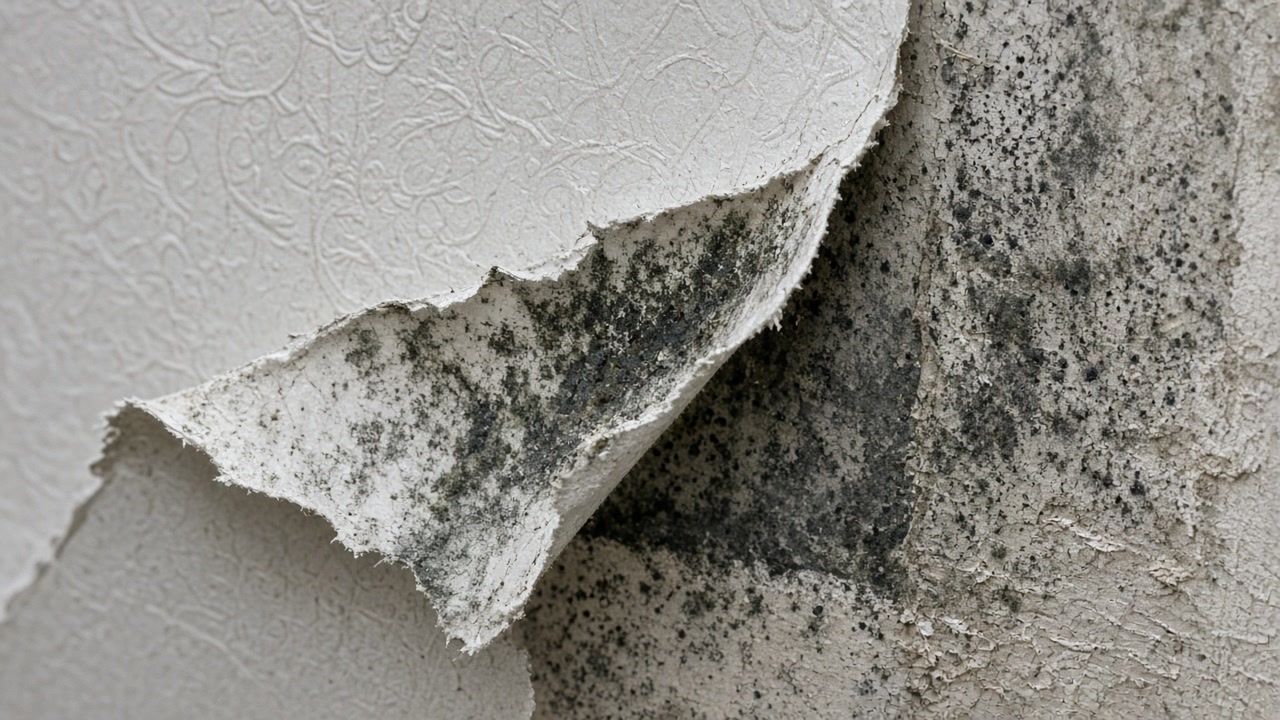
Because the condensation forms on the interior side of the low-permeance layer, the growth sits on the back of the wallpaper, the back of the drywall or the cavity side of the insulation. The Building America guidance describes exactly that: vapor migrating inward condenses on the cool, impermeable surface with no way to dry to the interior. What a homeowner experiences is a smell for months with nothing to look at, and then one day a stain that appears to come from nowhere, because the source is the room's own air conditioning rather than a pipe or a roof. If that is your sequence, chasing the roof will not settle it. A small inspection square cut in the right place will, and the right place is decided by moisture readings rather than by where the stain surfaced.
People here say the wall is sweating, and that is literally what it is
It is the most accurate phrase anyone uses about this problem and it is used by people with no building science training at all. A glass of iced tea sweats because its surface is below the dew point of the air around it. A cooled exterior wall in July is in the same situation, which is why the phrase survives. The LSU AgCenter states the correct assembly for this climate directly: moisture flows from outside to inside most of the year, so the ideal frame wall keeps the interior side fully permeable and puts the air barrier and the vapor retarder on the exterior side. It goes further, and this is the line worth remembering before anyone sells you an upgrade: having no vapor barrier on the interior side matters more than having one on the outside, and none is preferable to one on the wrong side. Taking the vinyl off an exterior wall is a genuine repair in this climate, not redecorating.
When it is the equipment rather than the wall
An air conditioner dehumidifies by doing the same thing to the air on purpose that the wall is doing by accident: holding a surface below the dew point so the water comes out of the air. That is where the water in the condensate drain comes from, and it is a lot of water in a July here. So the ordinary equipment faults are worth ruling out before anyone opens a wall. A drain line that has stopped draining puts that water somewhere else. An air handler in a closet is a cold, wet box in a warm house. And a unit that cools the rooms quickly but runs in short bursts is not running long enough to take much water out, which shows up as a house that feels cold and clammy at once. There is a cheap test that settles all three. Put a hygrometer in the room and read it while the system is running in August. The EPA's target is 30 to 60 percent indoor relative humidity and the CDC's is no higher than 50 percent all day long. If the equipment is running and the reading will not come down to those numbers, the problem is mechanical and no amount of cleaning a wall will fix it.
Under a raised house the foundation vents do the same job
The Building America Solution Center is explicit about this: during warm seasons in humid climates the outside air can contain more water vapor than the air in the crawl space, so rather than helping to dry it out, the vents can encourage condensation by letting warm humid air in to condense on the floor joists, which are likely to be cooler, especially if the rooms above are air conditioned. That is the same mechanism as the wall, at full scale, under a great deal of this metro's housing. The openings usually cannot simply be blocked. Federal regulation 44 CFR 60.3(c)(5) requires enclosed areas below the lowest floor to have at least two openings totaling not less than one square inch for every square foot of enclosed area, with the bottom of every opening no higher than one foot above grade, so the vent area under your house is set by rule and can be calculated from the footprint. The fix is flood-rated closures that seal against air, plus a ground cover and insulation, which is a design decision rather than a cleanup. If your floors feel cool and the smell is worst in August, look under the house first.
Metairie and Kenner were built in the decades this started
The American Community Survey puts Metairie's median year built at 1972, with two decades accounting for almost half the whole stock: 16,528 units from the 1960s and 16,077 from the 1970s, and only 2.5 percent of the stock predating 1940. Kenner's median is 1978, with 9,493 units built in the 1970s alone and only 1.1 percent predating 1940. Those are the decades in which central air conditioning and sealed interior finishes arrived in this metro together, which is the exact combination that produces condensation inside an exterior wall. Marrero, median year 1972, is 76.8 percent detached single family, and a detached house has four exterior walls exposed to the inward drive rather than two. If you live in that stock, the age of your house is not the reason it is damp, and the first place to look is what is on the inside face of the wall rather than what is above the ceiling.
What to check before you accept a diagnosis of a hidden leak
Read the humidity in the worst month, find out what is on the room side of your exterior walls, and look at the back of it rather than the front. If the answer is vinyl, oil paint, polyethylene or a faced batt turned the wrong way, you have a probable cause before anyone starts looking for a pipe. The EPA's other route is worth knowing too: reduce the potential for condensation on cold surfaces such as windows, piping, exterior walls, roofs and floors by adding insulation, which warms the surface when you cannot dry the air. If the affected area is under about 10 square feet, the EPA says a homeowner can in most cases handle it themselves, and plenty of people here should. If it is larger, or you cannot tell where the water is arriving from, the useful purchase is a moisture investigation and a written scope, from a firm that is not the one selling you the removal. Louisiana makes that separation a legal duty above $7,500 and we keep to it at every price. Send us the details of what you are seeing and we will arrange the assessment first.
Sources used in this guide

The NOAA thirty year normals for 1991 to 2020 at the New Orleans airport station put the mean dew point at 75.2F in July and 75.1F in August. Dew point is the temperature at which the air in question starts giving up its water, so on the average July day the outdoor air here will condense on any surface held below about 75F.
Source: NOAA National Centers for Environmental Information, 2023 Local Climatological Data Annual Summary with Comparative Data, NEW ORLEANS, LOUISIANA (KMSY), WBAN 12916, accessed 2026-09-22
Mean dew point by month in the same NOAA normals table, in degrees F: January 45.7, February 48.5, March 55.1, April 60.8, May 68.0, June 73.5, July 75.2, August 75.1, September 71.5, October 63.0, November 54.9, December 48.5. The annual mean is 61.7F.
Source: NOAA National Centers for Environmental Information, 2023 Local Climatological Data Annual Summary with Comparative Data, NEW ORLEANS, LOUISIANA (KMSY), WBAN 12916, accessed 2026-09-22
The same NOAA normals give New Orleans 3,206 cooling degree days a year against 1,178 heating degree days, and 85.2 days a year with a maximum temperature at or above 90F.
Source: NOAA National Centers for Environmental Information, 2023 Local Climatological Data Annual Summary with Comparative Data, NEW ORLEANS, LOUISIANA (KMSY), WBAN 12916, accessed 2026-09-22
Mean relative humidity at the New Orleans airport station is 76 percent for the year, and by hour of the day it is 88 percent at 06 LST and 63 percent at 12 LST.
Source: NOAA National Centers for Environmental Information, 2023 Local Climatological Data Annual Summary with Comparative Data, NEW ORLEANS, LOUISIANA (KMSY), WBAN 12916, accessed 2026-09-22
The station normals record 16.8 days a year with heavy fog, defined as visibility of a quarter mile or less.
Source: NOAA National Centers for Environmental Information, 2023 Local Climatological Data Annual Summary with Comparative Data, NEW ORLEANS, LOUISIANA (KMSY), WBAN 12916, accessed 2026-09-22
The Department of Energy Building America county table classes Orleans, Jefferson, St. Bernard, Plaquemines, St. Tammany and St. John the Baptist parishes alike as Hot-Humid, IECC climate zone 2, moisture regime A.
Source: U.S. Department of Energy, Building America, Guide to Determining Climate Regions by County, Volume 7.3, August 2015, accessed 2026-09-22
The Louisiana amendment to the energy code states that all parishes in Louisiana shall be Climate Zone 2A warm humid climates. The warm humid designation is the trigger for the separate body of code and building science guidance on where a vapor retarder may and may not be placed.
Source: UpCodes, Louisiana Energy Code 2021, adopting the 2021 International Energy Conservation Code with Louisiana amendments, Chapter 3 General Requirements, accessed 2026-09-22
The guidance states that if the interior air of a home is relatively cooler and drier than the exterior air, water vapor will naturally migrate through the walls from outside toward the inside, and that where the wall contains a vapor retarder on the interior side of the insulation, the water vapor will condense on this cool, impermeable surface, with no way to dry to the interior.
Source: Pacific Northwest National Laboratory, U.S. Department of Energy Building America Solution Center, accessed 2026-09-22
The Building America Solution Center guidance for warm-humid climates is to not install materials with a perm rating of 0.1 or less in above-grade walls with air-permeable insulation, and states that such materials should not be installed on below-grade walls on the interior side of air-permeable insulation in any climate.
Source: Pacific Northwest National Laboratory, U.S. Department of Energy Building America Solution Center, accessed 2026-09-22
The same guidance sets the classes by measured permeance: a Class I vapor retarder is 0.1 perm or less, Class II is greater than 0.1 perm and not more than 1.0 perm, and Class III is greater than 1.0 perm and not more than 10 perm.
Source: Pacific Northwest National Laboratory, U.S. Department of Energy Building America Solution Center, accessed 2026-09-22
The Building America Solution Center lists as Class I vapor retarders, at 0.1 perm or less, rubber membranes, polyethylene film, glass, aluminum foil, sheet metal, foil-faced insulating sheathings, foil-faced non-insulating sheathings, and vinyl wall paper.
Source: Pacific Northwest National Laboratory, U.S. Department of Energy Building America Solution Center, accessed 2026-09-22
The LSU AgCenter states that in a hot-humid climate moisture flows from outside to inside most of the year, and that the ideal assembly of a frame wall keeps the interior side fully permeable and locates both an air barrier and water vapor retarder or barrier to the exterior side to minimize the entry of outside water vapor.
Source: LSU AgCenter, Bill Robinson and Claudette H. Reichel, Ideal Wall Assemblies for Hot-humid and Mixed-humid Climates, accessed 2026-09-22
The LSU AgCenter states that any moisture that gets in a wall must be able to dry to the inside, that the interior side of the wall should be as permeable as possible, and lists what that rules out: no vinyl wallpaper, no oil-based interior paints and no interior vapor barrier on insulation.
Source: LSU AgCenter, Bill Robinson and Claudette H. Reichel, Ideal Wall Assemblies for Hot-humid and Mixed-humid Climates, accessed 2026-09-22
The LSU AgCenter states that having no vapor barrier on the interior side is more important than having a vapor retarder on the outside, and that none is preferable to one on the wrong side.
Source: LSU AgCenter, Bill Robinson and Claudette H. Reichel, Ideal Wall Assemblies for Hot-humid and Mixed-humid Climates, accessed 2026-09-22
The same LSU AgCenter guidance describes a different ideal assembly for mixed-humid climates, where moisture flow changes direction between the cooling and heating seasons and the wall has to dry in both directions, and names kraft paper-faced insulation toward the interior and smart vapor retarder membranes as assemblies suited to that case and not to the hot-humid case.
Source: LSU AgCenter, Bill Robinson and Claudette H. Reichel, Ideal Wall Assemblies for Hot-humid and Mixed-humid Climates, accessed 2026-09-22
Four things become the condensing plane on an exterior wall in this climate, and all four are on the federal and university lists of what not to do in a warm-humid zone: vinyl wallpaper, which the Building America Solution Center classes at 0.1 perm or less; oil-based interior paint, which the LSU AgCenter names; polyethylene sheet on the interior face of the studs; and foil-faced or kraft-faced batt insulation installed with the facing toward the room.
Source: Pacific Northwest National Laboratory, U.S. Department of Energy Building America Solution Center, accessed 2026-09-22
Because the condensation forms on the interior side of a low-permeance layer, the growth sits on the back of the wallpaper, the back of the drywall or the cavity side of the insulation. The Building America Solution Center describes exactly this: water vapor migrating inward condenses on the cool, impermeable surface with no way to dry to the interior.
Source: Pacific Northwest National Laboratory, U.S. Department of Energy Building America Solution Center, accessed 2026-09-22
The CDC states that mold grows on paper, cardboard, ceiling tiles and wood, and can also grow in dust, paints, wallpaper, insulation, drywall, carpet, fabric and upholstery.
Source: Centers for Disease Control and Prevention, About Mold, accessed 2026-09-22
The EPA advises reducing indoor humidity to between 30 and 60 percent to decrease mold growth, by venting bathrooms, dryers and other moisture-generating sources to the outside, using air conditioners and dehumidifiers, increasing ventilation, and using exhaust fans when cooking, dishwashing and cleaning.
Source: United States Environmental Protection Agency, accessed 2026-09-22
The CDC advises keeping humidity levels in your home as low as you can, no higher than 50 percent, all day long.
Source: Centers for Disease Control and Prevention, About Mold, accessed 2026-09-22
The EPA advises preventing condensation by reducing the potential for condensation on cold surfaces such as windows, piping, exterior walls, roof or floors by adding insulation.
Source: United States Environmental Protection Agency, accessed 2026-09-22
The EPA advises that if the moldy area is less than about 10 square feet, less than roughly a three foot by three foot patch, in most cases a homeowner can handle the job themselves.
Source: United States Environmental Protection Agency, accessed 2026-09-22
The Building America Solution Center states that during warm seasons in humid climates the outside air can contain more water vapor than the air within the crawl space, and that rather than helping to dry out a crawl space, the vents can actually encourage condensation in the crawl space by allowing warm, humid air to enter and condense on the floor joists, which are likely to be cooler, especially if the rooms above are air conditioned.
Source: Pacific Northwest National Laboratory, U.S. Department of Energy Building America Solution Center, accessed 2026-09-22
The same guidance notes that in flood-prone areas of the United States local codes may require the installation of flood vents that allow water to pass freely into and out of a foundation to equalize pressure on the foundation walls, and advises choosing flood vents designed to reduce standby air leakage.
Source: Pacific Northwest National Laboratory, U.S. Department of Energy Building America Solution Center, accessed 2026-09-22
Federal regulation 44 CFR 60.3(c)(5) requires that fully enclosed areas below the lowest floor which are subject to flooding be designed to automatically equalize hydrostatic flood forces by allowing the entry and exit of floodwaters, and sets the minimum criteria as a minimum of two openings having a total net area of not less than one square inch for every square foot of enclosed area subject to flooding, with the bottom of all openings no higher than one foot above grade.
Source: Office of the Federal Register, Electronic Code of Federal Regulations, Title 44 Section 60.3, accessed 2026-09-22
This metro carries both foundation types on the same streets. Raised pier and beam construction with an open or vented space underneath dominates the pre-war stock and much of what has been rebuilt since, because federal rule 44 CFR 60.3(c)(2) requires the lowest floor to sit at or above the base flood level. Slab on grade dominates the post-war suburbs, where the American Community Survey puts the median year built at 1972 in Metairie, 1976 in Terrytown and 1978 in Kenner and Chalmette.
Source: Office of the Federal Register, Electronic Code of Federal Regulations, Title 44 Section 60.3, accessed 2026-09-22
Metairie has 66,355 housing units with a median year built of 1972. Two decades account for almost half the entire stock: 16,528 units were built between 1960 and 1969 and 16,077 between 1970 and 1979. Only 1,654 units, 2.5 percent, predate 1940, and 61.2 percent of the stock is single family detached.
Source: United States Census Bureau, American Community Survey 2020-2024 five year estimates, accessed 2026-09-22
Kenner has 27,908 housing units with a median year built of 1978, the second newest housing stock on the south shore. Only 296 units, 1.1 percent, predate 1940, the lowest pre-war share of any place in this service area apart from Belle Chasse. 9,493 units were built in the 1970s alone.
Source: United States Census Bureau, American Community Survey 2020-2024 five year estimates, accessed 2026-09-22
Marrero has 13,920 housing units with a median year built of 1972 and 76.8 percent of them, 10,697 units, are single family detached, one of the highest detached shares on the West Bank. 69.2 percent of the stock predates 1980 and 285 units are mobile homes.
Source: United States Census Bureau, American Community Survey 2020-2024 five year estimates, accessed 2026-09-22
Louisiana R.S. 37:2158(A)(19)(c) makes it a violation for a mold remediation contractor to perform both mold assessment and mold remediation on the same property.
Source: Louisiana State Licensing Board for Contractors, Contractors Licensing Law and Rules and Regulations, effective August 1, 2022, accessed 2026-09-22
Services this guide relates to
Need someone to look at it?
Send the details and we will come back to you.