
What Changes the Price of a Mold Job in New Orleans
Nobody can tell you honestly before they have looked inside the wall, and this site will not print a number it cannot stand behind. What we can tell you is exactly what moves it: the measured area rather than the visible one, whether the water has stopped arriving, your foundation type, how much has to be opened up and put back, and whether the job crosses the $7,500 line where Louisiana's written report and separation duties begin.
Already know you need someone out? Call (315) 640-3590.
The measured area, which is almost never the area you can see
Price follows the area that has to be removed, and in this climate that is routinely larger than the patch on the wall. The EPA uses about 10 square feet, a patch roughly three feet by three feet, as the line below which a homeowner can in most cases handle the job themselves, and that is a useful anchor for thinking about scale. The trap here is that the condensation forms on the interior side of a low-permeance layer, so the growth sits on the back of the wallpaper, the back of the drywall or the cavity side of the insulation, and the visible stain is where it finally surfaced rather than where it is. Two quotes that differ wildly usually differ because one of them opened an inspection square and the other estimated from the room. Ask which one you are holding.
Whether the water has actually stopped arriving
This is the largest single factor and it is the one most often left out of a quote. The EPA's position is that the way to control indoor mold growth is to control moisture, and that wet or damp material dried within 24 to 48 hours will in most cases not grow mold. A job priced against a source that is still running is a job priced to be done twice, once now and once next summer. So the honest sequence costs more on paper at the start and less in total: find the water, stop the water, then remove what the water damaged. A scope that opens with demolition and never names a moisture source is cheaper to buy and more expensive to own.
Your foundation type, because the two fail in different places
This metro carries both on the same streets and they share no symptoms. Raised pier and beam with a vented space underneath dominates the pre-war stock and much of what has been rebuilt since, because federal rule 44 CFR 60.3(c)(2) requires the lowest floor to sit at or above the base flood level. On that house the water condenses under the floor, because the Building America guidance says warm humid outdoor air entering the vents condenses on joists that are cooler when the rooms above are air conditioned, and the smell arrives long before any stain. Slab on grade dominates the post-war suburbs, with median years built of 1972 in Metairie, 1976 in Terrytown and 1978 in Kenner and Chalmette. There the plumbing is cast into the concrete, the water wicks up into the bottom plate, and the stain shows a foot from the break. Access is what costs money: a crawl space you can work in and a slab you have to open are not the same price for the same square footage.
How much has to be opened up, and what putting it back costs
Removal is usually the cheaper half. Reinstatement is where the number moves, and it moves with what the material is and whether a permit is involved. The EPA says absorbent or porous materials such as ceiling tiles and carpet may have to be thrown away if they become moldy, so expect a scope to name what leaves the building rather than promising to clean everything. The City of New Orleans states that a permit is needed to construct, enlarge, alter, repair, move, demolish or change the occupancy of a building, while interior painting, papering and similar finish work is exempt. Opening a wall and replacing framing is on the permit side of that line, so ask who is pulling it and whether the price includes it.
The 50 percent of value line, which turns a repair into a rebuild
This is the local cost risk nobody warns about. The City of New Orleans building permit application requirements call for a benchmark certificate completed by a registered land surveyor on the city's three-part form, with original seals, stamped and dated within the last six months, for new construction, additions and renovations where the work will exceed 50 percent of the value of the structure. A large mold repair on a modest house can cross that threshold, and crossing it makes the work a substantial improvement that has to meet current flood elevation rules. The difference between a repair and a substantial improvement is not a percentage on an invoice, it is a different project. Ask for the value calculation before work starts, not after somebody has already opened the wall.
Pre-war houses, plaster, and a wall you share with next door
New Orleans holds one of the largest concentrations of pre-war housing in the country: 61,327 of its 195,552 units, 31.4 percent, date from 1939 or earlier, against 6.1 percent for Louisiana as a whole and 11.7 percent nationally. That stock costs more to repair well, because plaster, original trim and old growth framing are slower to open and slower to put back than drywall. It also raises a question no modern subdivision does. Only 46.0 percent of the city's stock is single family detached: 28,986 units sit in two unit buildings and 19,407 are single family attached, the shotgun doubles and row forms that share a party wall. A shared wall can mean a shared moisture source, and if the water is entering on the other side of it, no amount of work on your side will stop it. That possibility has to be settled during the assessment or it is priced into the wrong job.
Whether the cause is the room's own air, which is the cheap answer
Sometimes the investigation produces the least expensive outcome available, and it is worth knowing that before you buy one. Four finishes turn an exterior wall into a condensing plane in this climate, and all four are on federal or LSU AgCenter lists of what not to do in a warm humid zone: vinyl wallpaper, which the Building America Solution Center classes at 0.1 perm or less, oil-based interior paint, polyethylene sheet on the interior face of the studs, and foil-faced or kraft-faced batt with the facing turned toward the room. The LSU AgCenter's own conclusion is the useful one: having no vapor barrier on the interior side matters more than having one on the outside, and none is preferable to one on the wrong side. Stripping the vinyl off an exterior wall is a real repair here, and it is a fraction of the cost of anything else on this page.
Drying equipment, because you cannot open a window in this city
If the material is still wet, drying is a line on the quote and it is equipment rental rather than labor. It is also not optional here in the way it might be elsewhere. The EPA advises drying within 24 to 48 hours, but the outdoor air in that window carries a mean dew point of 75.2F in July and 75.1F in August, with mean relative humidity of 88 percent at 6am, so outdoor air brought into a wet building in summer adds water rather than removing it. Reaching the CDC's ceiling of no higher than 50 percent indoors means a closed house with mechanical dehumidification running, and that is a purchase rather than a habit. A drying scope should say what equipment, for how long, and to what measured reading, because those three things are what you are paying for.
The $7,500 line, and what it changes about the paperwork
Louisiana defines a mold remediation contractor as someone whose mold work exceeds seven thousand five hundred dollars in labor and materials, so that figure is where the written report duty and the separation rule switch on. It is worth knowing which side of it your job sits, because it changes what you can insist on rather than merely request. It is also worth reading a quote that lands just under it with open eyes. R.S. 37:2158(B)(1) disregards any division of a contract into parts that would avoid the need for a license and treats the parts as one, which is the legislature telling you in advance that splitting is the move. Two invoices for one wall is a thing to notice, not an accusation.
Two sets of hands, and why that is not double billing
Above the threshold, R.S. 37:2158(A)(19)(c) and (d) make it a violation for one contractor, or for two entities under one owner, to perform both the mold assessment and the mold remediation on the same property. So a legitimate large job in Louisiana has two firms in it and two lines on the budget. That reads as more expensive and frequently is not, because the firm writing the scope has no interest in the scope being large. The one-stop version can be cheaper on the day and is priced by the person who decides how much comes out. We arrange the two separately at every price, including under the threshold where nothing in the statute requires it.
What is not worth paying for
Air testing, usually. The EPA states that in most cases, if visible mold growth is present, sampling is unnecessary, and that since no EPA or other federal limits have been set for mold or mold spores, sampling cannot be used to check a building's compliance with federal standards. The CDC states that it does not recommend mold testing. So a laboratory page in a report has no pass mark to be measured against, and money spent on it is money not spent finding the water. The second thing is spraying. The EPA says use of a chemical or biocide that kills mold, chlorine bleach for example, is not recommended as a routine practice during cleanup. A quote that is mostly chemical application, with no removal and no moisture work, is not following the federal guidance whatever it costs.
How to get a number you can actually compare
Get the assessment first and get it in writing, with the moisture readings, the extent, and a scope specific enough that two removal firms would price the same work. Then check both names on the board's Contractor Search, which is free and takes a contractor name, license number, city, parish and qualifying party, and returns only currently active licenses. Confirm which authority holds your permit file, because nine of the sixteen places we cover have no municipal government of their own and the parish is the authority. One local note worth carrying if you are in Kenner or Harvey: the peer-reviewed satellite measurement of ground movement records rates from 2 to more than 20 millimeters a year in those areas, so a new crack or a door that has stopped closing is worth mentioning to the assessor, because ground movement is what opens the pipe joint that feeds the mold. Send us what you have and we will arrange the assessment.
Sources used in this guide

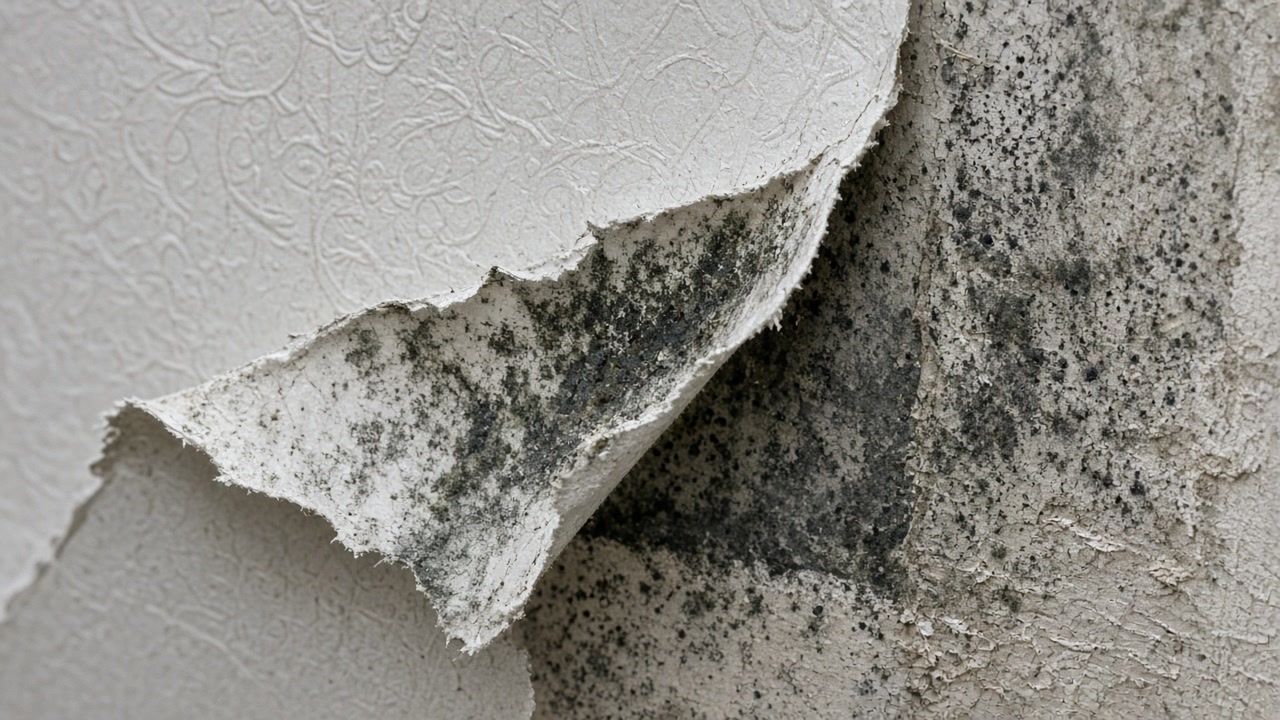
The EPA advises that if the moldy area is less than about 10 square feet, less than roughly a three foot by three foot patch, in most cases a homeowner can handle the job themselves.
Source: United States Environmental Protection Agency, accessed 2026-09-22
Because the condensation forms on the interior side of a low-permeance layer, the growth sits on the back of the wallpaper, the back of the drywall or the cavity side of the insulation. The Building America Solution Center describes exactly this: water vapor migrating inward condenses on the cool, impermeable surface with no way to dry to the interior.
Source: Pacific Northwest National Laboratory, U.S. Department of Energy Building America Solution Center, accessed 2026-09-22
The EPA states that wet or damp building materials and furnishings should be cleaned and dried within 24 to 48 hours to prevent mold growth, and that if wet or damp materials or areas are dried 24 to 48 hours after a leak or spill happens, in most cases mold will not grow.
Source: United States Environmental Protection Agency, accessed 2026-09-22
The EPA states that there is no practical way to remove every mold spore from an indoor space, and that the way to control indoor mold growth is to control moisture.
Source: United States Environmental Protection Agency, accessed 2026-09-22
This metro carries both foundation types on the same streets. Raised pier and beam construction with an open or vented space underneath dominates the pre-war stock and much of what has been rebuilt since, because federal rule 44 CFR 60.3(c)(2) requires the lowest floor to sit at or above the base flood level. Slab on grade dominates the post-war suburbs, where the American Community Survey puts the median year built at 1972 in Metairie, 1976 in Terrytown and 1978 in Kenner and Chalmette.
Source: Office of the Federal Register, Electronic Code of Federal Regulations, Title 44 Section 60.3, accessed 2026-09-22
The Building America Solution Center states that during warm seasons in humid climates the outside air can contain more water vapor than the air within the crawl space, and that rather than helping to dry out a crawl space, the vents can actually encourage condensation in the crawl space by allowing warm, humid air to enter and condense on the floor joists, which are likely to be cooler, especially if the rooms above are air conditioned.
Source: Pacific Northwest National Laboratory, U.S. Department of Energy Building America Solution Center, accessed 2026-09-22
The EPA states that absorbent or porous materials such as ceiling tiles and carpet may have to be thrown away if they become moldy.
Source: United States Environmental Protection Agency, accessed 2026-09-22
The City of New Orleans states that building permits are issued by the Department of Safety and Permits, that a permit is needed to construct, enlarge, alter, repair, move, demolish, or change the occupancy of a building or structure, and that interior painting, papering and similar finish work is exempt. The guide directs anyone uncertain about whether a permit is needed to call the Building Division.
Source: City of New Orleans, Guide to Building Permits, accessed 2026-09-22
The City of New Orleans building permit application requirements list a benchmark certificate completed by a registered land surveyor on the city's three-part form, with original seals, stamped and dated within the last six months, among the items required for new construction, additions, and renovations where the work will exceed 50 percent of the value of the structure.
Source: City of New Orleans, Department of Safety and Permits, Building Permit Application Requirements, accessed 2026-09-22
Five of the sixteen places in this service area are Census designated places with no municipal government of their own. The Census Bureau's 2024 gazetteer records Metairie, Harvey, Marrero, River Ridge and Terrytown as CDPs, along with Chalmette, Arabi, Belle Chasse and Laplace. New Orleans, Kenner, Gretna, Westwego, Slidell, Mandeville and Covington are incorporated cities.
Source: United States Census Bureau, 2024 Gazetteer Files, Places, Louisiana, accessed 2026-09-22
31.4 percent of New Orleans housing units, 61,327 of 195,552, were built in 1939 or earlier. The Louisiana figure is 6.1 percent and the national figure is 11.7 percent. No other place in this service area comes close: Gretna is next at 16.5 percent, then Arabi at 11.4 percent.
Source: United States Census Bureau, American Community Survey 2020-2024 five year estimates, accessed 2026-09-22
New Orleans has 195,552 housing units with a median year built of 1960. 61,327 of them, 31.4 percent, date from 1939 or earlier and 73.7 percent predate 1980. Only 46.0 percent of the stock is single family detached: 28,986 units sit in two unit buildings and 19,407 are single family attached, the shotgun doubles and row forms that share a party wall.
Source: United States Census Bureau, American Community Survey 2020-2024 five year estimates, accessed 2026-09-22
Four things become the condensing plane on an exterior wall in this climate, and all four are on the federal and university lists of what not to do in a warm-humid zone: vinyl wallpaper, which the Building America Solution Center classes at 0.1 perm or less; oil-based interior paint, which the LSU AgCenter names; polyethylene sheet on the interior face of the studs; and foil-faced or kraft-faced batt insulation installed with the facing toward the room.
Source: Pacific Northwest National Laboratory, U.S. Department of Energy Building America Solution Center, accessed 2026-09-22
The LSU AgCenter states that having no vapor barrier on the interior side is more important than having a vapor retarder on the outside, and that none is preferable to one on the wrong side.
Source: LSU AgCenter, Bill Robinson and Claudette H. Reichel, Ideal Wall Assemblies for Hot-humid and Mixed-humid Climates, accessed 2026-09-22
The EPA advises drying wet materials within 24 to 48 hours. In New Orleans the outdoor air in that window carries a mean dew point of 75.2F in July and 75.1F in August, with mean relative humidity of 88 percent at 6am, so outdoor air brought into a wet building in summer adds water rather than removing it.
Source: NOAA National Centers for Environmental Information, 2023 Local Climatological Data Annual Summary with Comparative Data, NEW ORLEANS, LOUISIANA (KMSY), WBAN 12916, accessed 2026-09-22
The CDC advises keeping humidity levels in your home as low as you can, no higher than 50 percent, all day long.
Source: Centers for Disease Control and Prevention, About Mold, accessed 2026-09-22
The NOAA thirty year normals for 1991 to 2020 at the New Orleans airport station put the mean dew point at 75.2F in July and 75.1F in August. Dew point is the temperature at which the air in question starts giving up its water, so on the average July day the outdoor air here will condense on any surface held below about 75F.
Source: NOAA National Centers for Environmental Information, 2023 Local Climatological Data Annual Summary with Comparative Data, NEW ORLEANS, LOUISIANA (KMSY), WBAN 12916, accessed 2026-09-22
Louisiana R.S. 37:2150.1(11) defines the regulated person by the size of the job: a mold remediation contractor means any person who engages in removal, cleaning, sanitizing, demolition, or other treatment, including preventative activities, of mold or mold-contaminated matter that was not purposely grown at that location and where the costs for such labor and materials exceed seven thousand five hundred dollars. Mold remediation applies only to the regulation of mold-related activities that affect indoor air quality and does not apply to routine cleaning when not conducted for the purpose of mold-related activities intended to affect indoor air quality.
Source: Louisiana State Licensing Board for Contractors, Contractors Licensing Law and Rules and Regulations, effective August 1, 2022, accessed 2026-09-22
Louisiana R.S. 37:2158(B)(1) provides that in determining the value of a project, any division of a contract or scope of work into parts which would avoid the necessity of a license to bid, contract, or perform the work, will be disregarded, and the divided parts of the contract or scope of work will be treated as one contract or scope of work for purposes of determining whether a license is required.
Source: Louisiana State Licensing Board for Contractors, Contractors Licensing Law and Rules and Regulations, effective August 1, 2022, accessed 2026-09-22
Louisiana R.S. 37:2158(A)(19)(c) makes it a violation for a mold remediation contractor to perform both mold assessment and mold remediation on the same property.
Source: Louisiana State Licensing Board for Contractors, Contractors Licensing Law and Rules and Regulations, effective August 1, 2022, accessed 2026-09-22
Because Louisiana R.S. 37:2158(A)(19)(c) and (d) bar one entity, and any commonly owned entity, from performing both the assessment and the remediation on a property, an arrangement that routed both halves of a job above $7,500 to the same firm, or to two firms under one owner, would put that contractor in violation of the state licensing statute.
Source: Louisiana State Licensing Board for Contractors, Contractors Licensing Law and Rules and Regulations, effective August 1, 2022, accessed 2026-09-22
Where mold growth can already be seen, EPA guidance says sampling is in most cases unnecessary.
Source: United States Environmental Protection Agency, accessed 2026-09-22
The CDC states that it does not recommend mold testing.
Source: Centers for Disease Control and Prevention, About Mold, accessed 2026-09-22
The EPA states that since no EPA or other federal limits have been set for mold or mold spores, sampling cannot be used to check a building's compliance with federal mold standards.
Source: United States Environmental Protection Agency, accessed 2026-09-22
The EPA states that the use of a chemical or biocide that kills organisms such as mold, chlorine bleach for example, is not recommended as a routine practice during mold cleanup.
Source: United States Environmental Protection Agency, accessed 2026-09-22
The board publishes a free public contractor search that can be queried by contractor name, license number, city, parish, type of contractor and qualifying party, and returns only contractors whose license or registration is currently active. The page carries the board's own caution that the information is provided as a courtesy and may not reflect recent changes or updates.
Source: Louisiana State Licensing Board for Contractors, contractor search, accessed 2026-09-22
Louisiana R.S. 37:2158(A)(19)(a) makes it a violation for a mold remediation contractor to fail to provide a written report to each person for whom he performs such services for compensation.
Source: Louisiana State Licensing Board for Contractors, Contractors Licensing Law and Rules and Regulations, effective August 1, 2022, accessed 2026-09-22
The same study measured the maximum urban rates of elevation loss, between 30 and 47 millimeters a year, in the area around Louis Armstrong International Airport, and rates from 2 to more than 20 millimeters a year in areas including Kenner and Harvey.
Source: Fiaschi, Allison and Jones, Vertical land motion in Greater New Orleans, Science Advances, via PubMed Central, accessed 2026-09-22
Services this guide relates to
Need someone to look at it?
Send the details and we will come back to you.